

For decades, financial advisors built successful firms primarily through referrals and relationships. That hasn’t changed. But today, a referral is rarely the only factor someone considers before reaching out.
Today’s investors don’t hear about your firm and immediately schedule a consultation. They Google you. They read your website. They compare you to competitors. They look for reviews. And today, they’re asking AI platforms like ChatGPT and Gemini questions about their financial situation before deciding who they should trust.
Your reputation may earn the referral. Your digital presence is what helps turn that referral into a conversation.
According to Wealthtender’s 2025 consumer study of affluent households planning to hire a financial advisor, nearly 50% of prospective clients plan to use search engines like Google or Bing during their advisor search, while 25% plan to use AI-powered search tools. Perhaps most importantly, 96% of prospects who receive a referral still conduct online research before making contact.
If your digital presence doesn’t answer their questions or communicate your expertise, prospective clients will continue their search elsewhere.
That’s why today’s SEO for financial advisors goes beyond Google rankings. It’s about showing up wherever prospective clients are researching who to trust with their financial future.
What is Finance SEO?
Finance SEO is the process of making your firm easier to find, evaluate, and trust online when prospective clients are looking for financial guidance.
For RIAs and wealth management firms, finance SEO typically includes:
- Strategic keyword research
- Educational content that answers investor questions
- Local SEO to improve visibility in your community
- Technical website improvements
- Answer Engine Optimization (AEO)
- Reputation and thought leadership building
- User experience optimization
- Structured data implementation
Effective SEO marketing for financial services ensures your firm appears when investors are searching for questions like:
- Do I need a financial advisor?
- What’s the difference between a wealth manager and an RIA?
- How much money should I have before hiring an advisor?
- Retirement planning strategies for business owners
- Financial advisor near me
- Wealth management services in my area
In other words, SEO isn’t just about helping prospective clients find your financial firm. Search helps prospects feel confident choosing it.
How Today’s Investors Choose a Financial Advisor
Consumers are increasingly comfortable beginning their financial planning journeys online. Gallup research found that 36% of Americans seek financial information from financial websites, making digital resources one of the most common places consumers turn for financial guidance.
For many firms, the path from referral to first meeting looks something like this:
A prospect hears about your firm from their CPA or a colleague.
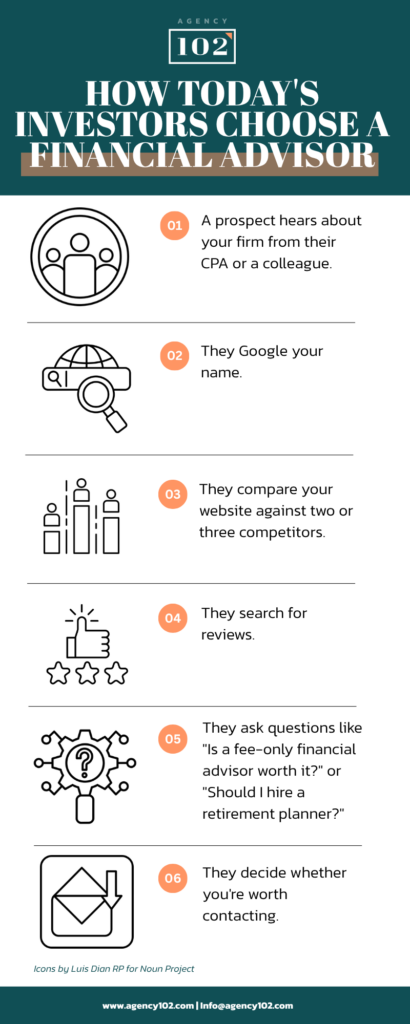
Your website is now functioning as your firm’s first impression, and increasingly, that first impression happens before you’ve ever spoken with a prospective client.
Why SEO Matters for Financial Services Firms
Most investors don’t choose the first advisor they find. They choose the one who gives them the most confidence.
The benefits of improving SEO for financial services include:
- Attract more qualified prospective clients
- Build trust before the first consultation
- Increase visibility in Google and AI search
- Support and strengthen referral-based growth
- Demonstrate expertise through educational content
- Reduce reliance on paid advertising over time
- Create a long-term marketing asset that continues working for your firm
Unlike paid campaigns, SEO compounds over time. A well-written article answering a client’s question today can continue driving qualified traffic for years.
For wealth management firms, that’s particularly valuable because client relationships are measured in decades.
What Are the Biggest SEO Challenges Within Financial Services?
Challenge #1: Building Trust Online
Before a prospective client trusts your advice, they first need to trust your firm.
More than 80% of consumers say online reviews are important or very important when evaluating financial services providers, highlighting the growing importance of a firm’s overall digital presence.
Trust signals now include:
- Helpful educational content that demonstrates expertise
- Client reviews and testimonials (where compliant)
- Professional credentials and advisor bios
- Thought leadership and media mentions
- Community involvement and local reputation
- A modern, trustworthy website
- Strong visibility in Google and AI search
Challenge #2: Highly Competitive Search Results
Prospective clients have thousands of options when they search for a financial advisor online. Standing out takes more than targeting broad, high-volume keywords.
Some of the most competitive searches include:
- Financial advisor
- Wealth management
- Retirement planning
- Estate planning
- Investment management
Rather than trying to rank for every broad keyword, successful firms often focus on building authority around their specialties, service areas, and the questions their ideal clients are already asking. Over time, that expertise helps improve visibility for more competitive searches as well.
The data below illustrates why this matters. While these searches attract significant monthly traffic, they’re also among the most competitive keywords in SEO.
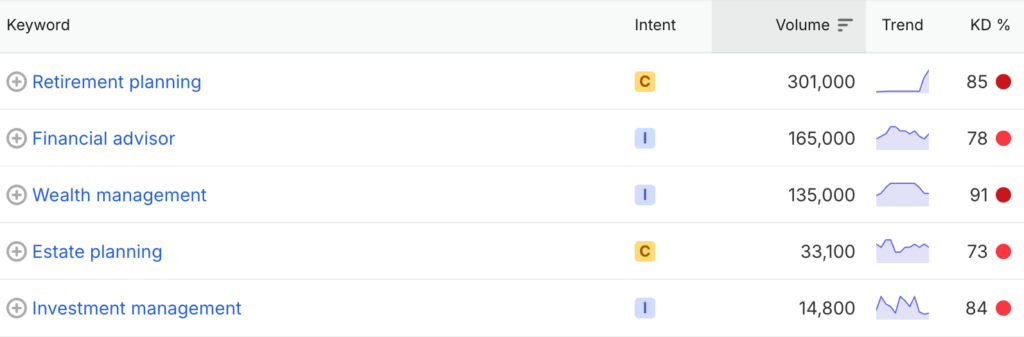
That doesn’t mean smaller firms can’t compete. It means they need a more strategic approach. Instead of trying to outrank national brands for every broad keyword, successful firms build visibility through niche expertise, local SEO, educational content, and consistent authority over time.
Challenge #3: AI Search is Changing Discovery
Google isn’t the only place prospective clients are searching anymore.
According to Wealthtender’s research, one in four prospective clients plans to use AI search tools when researching financial advisors. These users aren’t typing “financial advisor near me.” They’re asking highly personalized questions about their circumstances.
Examples include:
- “Find a fee-only financial advisor that specializes in physicians.”
- “Who helps business owners prepare for retirement?”
- “What questions should I ask a wealth manager before hiring them?”
The firms creating clear, helpful, search-friendly answers will have a competitive advantage across both traditional and AI-powered search experiences.
What Are the Best SEO Strategies for Financial Services Firms?
1. Answer the Questions Your Ideal Clients Are Already Asking
The most effective finance SEO strategies begin by understanding what investors actually want to know.
Instead of focusing exclusively on your services, answer questions like:
- How do I know if I need a financial advisor?
- What should I ask before hiring a wealth manager?
- What retirement planning mistakes should I avoid?
- What’s the difference between fiduciary and non-fiduciary advice?
Every helpful answer is another opportunity for prospective clients—and increasingly AI search platforms—to discover your expertise.
2. Invest in Local SEO
Most financial advisors don’t need nationwide visibility. They need to be highly visible in the communities where they build relationships and meet clients.
Local SEO strategies should include:
- Location-specific service pages
- A complete, active Google Business Profile
- Compliance-friendly review strategy
- Community involvement and locally relevant content
- Local keyword targeting
- Consistent business listings
We’ve found that investors are searching for advisors who understand their specific communities. Local visibility remains one of the most valuable investments firms can make in their search strategy.
That’s part of the strategy for our client, The Kelly Group, a Bel Air, Maryland-based wealth management firm highly active in the Harford County community. Beyond optimizing their local search presence, we maintain a community-focused Happenings section on their website featuring local events, partnerships, and initiatives. This reinforces their connection to Harford County while strengthening the local signals that search engines value.

3. Demonstrate Your Expertise
People invest in people.
Thought leadership remains one of the most powerful differentiators for financial services firms because it allows prospective clients to experience your expertise before they ever speak with your team.
Examples include:
- Market commentary
- Retirement planning resources
- Educational guides
- Video content
- FAQs
- Community initiatives
- Financial planning insights
At Agency 102, we don’t separate content marketing from SEO. The most effective financial services strategies use both to answer client questions while demonstrating expertise in ways prospective clients—and search engines—can easily understand.
4. Structure Your Content for AI Search
As more investors turn to AI platforms like ChatGPT, Gemini, and Google’s AI Overviews, the way content is structured has become just as important as the content itself. Answer Engine Optimization (AEO) helps your website provide clear, organized information that both people and AI can easily understand.
Best practices include:
- Question-based headings that match how people search
- Concise answers to common investor questions
- FAQ sections that provide quick, scannable information
- Structured data to help search engines understand your content
- Clear formatting that improves readability
- Conversational language that mirrors how prospects ask questions
For a guide, check out The Kelly Group’s blog post about a 457(b) Plan that our team researched and developed, structured using question-based headings, formatted tables, and concise answers.
And remember, the goal isn’t to write exclusively for AI. It’s to create content that’s clear enough for both prospective clients and AI search tools to understand and recommend.
5. Improve Technical SEO
Even exceptional content can’t overcome a poor website experience.
Technical SEO helps search engines access, understand, and recommend your website while creating a better experience for prospective clients.
Examples of technical SEO improvements can include:
- Fast page speeds to keep visitors engaged
- Mobile-friendly pages for people researching on their phones
- Optimized page titles and meta descriptions to improve visibility in search results
- Strong internal linking that helps visitors and search engines navigate your website
- Accessible website design that creates a better experience for all users
- Structured schema markup that helps Google and AI understand your content
Financial Services SEO in Action
In Year 3 of our partnership with The Kelly Group, our goal continues to be to better communicate their expertise, community leadership, and value proposition across digital channels, and, as a result, increase local visibility of their brand and services and increase potential client inquiries.
By combining content marketing, SEO, social media, and community storytelling, we help continue digital and organic growth, including:
- 34.85% year-over-year growth in organic search traffic
- 32.67% increase in total website sessions
- Rankings for 270 high-value keywords
- More than doubling their LinkedIn following
- Significant increases in engaged website sessions and social reach
Their continued success is driven by an integrated strategy designed to build visibility and trust over time.
Should You Hire a Finance SEO Agency?
Many firms reach a point where managing content creation, SEO, technical improvements, and performance reporting internally becomes difficult to balance on top of advisors’ current workloads.
The right financial marketing company should provide:
- Financial services marketing expertise
- SEO and AEO strategies
- Keyword research
- Technical SEO audits
- Content marketing support
- Performance reporting
- Ongoing optimization
Ready to Build a Financial Search Strategy That Works?
Whether you’re an RIA, wealth management firm, or financial services organization, your digital presence should work as hard as you do.
At Agency 102, we combine SEO, Answer Engine Optimization, content marketing, and financial services expertise to create strategies that build visibility, credibility, and client growth over time.
If you’re ready to create a search strategy that reflects the expertise you’ve spent years building, we’d love to talk.