

Many business owners are understandably skeptical when they hear marketing agencies talk about SEO, content strategy, and “long-term visibility.”
It can sound abstract. Slow. Expensive. Hard to measure.
We get it.
That’s exactly why, in Q4 last year, we decided to run our own experiment.
Instead of just telling clients what works, we committed to doing the same thing for Agency 102 that we recommend to our partners in healthcare, financial services, and first responder organizations.
We treated our own website like a real client project. Set clear goals, built a strategy, created new pages, published with intention, and tracked results over time.
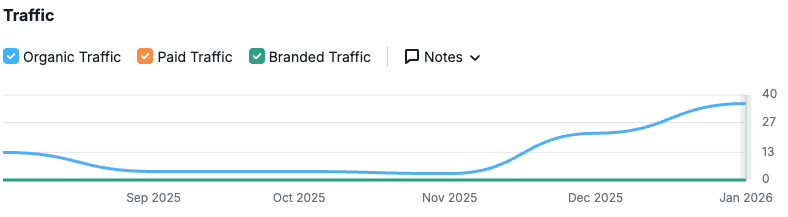
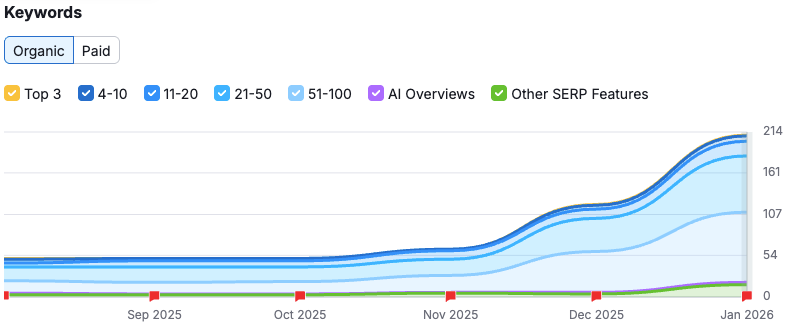
In just 4 months, we achieved:
- 75% increase in ranking keywords
- 64% increase in organic search traffic
- 8+ qualified new business leads directly tied to SEO-driven pages
More importantly, those leads were exactly the kinds of clients we want to work with: mission-driven organizations looking for long-term marketing partners, not one-off projects.
Below is exactly how we did it.
Step 1: Identified Our Business Goals and Target Audience
Before diving into keyword research or writing a single page, we started with strategy. We find this is often the most overlooked step and the one that determines whether everything else works or feels like shooting in the dark.
We asked ourselves:
- Who do we want to work with?
- Where do we add the most value?
- What kinds of projects do we want more of?
For Agency 102, our priority audiences were:
- First responder organizations (fire/EMS)
- Medical groups and healthcare providers
- Financial services firms and credit unions
Our goals were simple but specific:
- Increase visibility in Google and AI for niche service lines
- Position Agency 102 as a true expert in these industries
- Attract inbound qualified leads that were educated about what we do
- Reduce the need for cold outreach
This clarity shaped everything that came next.
Step 2: Made a Strategy for Web Content
Instead of randomly blogging or tweaking pages, we mapped out a clear content architecture.
We treated our site like a funnel:
Top of funnel (educational content):
- Thought leadership blogs
- Marketing insights (like this data-driven blog)
- Industry trends
Middle of funnel (service clarity):
- Pages that clearly explained how we work
- Case studies (like Falls Church VFD)
- Industry-specific marketing pages (like this one for First Responder marketing)
Bottom of funnel (conversion):
- Clear calls to action
- Easy ways to book a consult
- Contact forms tied to specific services
This is the same model we build for our clients and it works well because it aligns with how people research products and services and make decisions.
Step 3: Conducted Keyword Research
This is where the technical SEO work began. At Agency 102, we use premium SEO and AEO tools like SEMRush, but you don’t need enterprise software to start. Even Google’s search results can reveal valuable keyword and question trends.
We analyzed:
- What people were already searching related to our services
- What our competitors ranked for
- Where we had opportunities to win
We identified high-intent search phrases like:
- “marketing services for first responders”
- “credit union marketing agency”
- “medical group marketing services”
- “financial marketing agency”
Rather than forcing these into existing pages, we decided to create new, purpose-built pages designed to rank for each topic.
Step 4: Implemented New Content to the Website
Next, we built cornerstone service pages that aligned directly with our strengths:
Marketing Services for First Responders
This page highlights our work with volunteer fire departments and EMS organizations, recruitment marketing, community engagement, and SAFER-funded projects.
Credit Union Marketing Agency
We focused on compliance-friendly storytelling, member growth, and digital visibility for local credit unions.
Medical Group Marketing Services
This page speaks to healthcare providers who want patient acquisition without sacrificing trust or professionalism.
Financial Marketing Agency
Here, we emphasize compliant, relationship-driven marketing for advisors and firms.
Each page included:
- Clear explanations of what we do
- Data points
- Examples of relevant, past work
- Industry-specific language
- Strong calls to action
- Relevant certifications and awards
- A FAQ section
These weren’t sales-heavy pages. They were educational, practical, and tailored to each audience.
Step 5: Submitted New Pages for Indexing
Once the pages were live, we submitted them through Google Search Console to ensure fast indexing.
Then we tracked:
- Keyword rankings
- Organic impressions
- Click-through rate
- Lead form submissions
SEO is not instant, but within weeks, we started seeing meaningful movement.
That’s where the 75% increase in ranking keywords and 64% traffic growth came from in under 4 months.
Step 6: Create Pillar Content to Reinforce Authority
Finally, we strengthened everything with pillar content: in-depth blogs that connected back to our service pages.
For example, we published insights like:
- How first responder departments can recruit volunteers online
- Why credit unions need local SEO
- How medical practices can balance compliance and digital marketing
- What financial advisors should prioritize in 2026
Each blog linked strategically to our new service pages, reinforcing authority in Google’s eyes.
What This Means for You
We didn’t achieve these results through shortcuts, paid ads, or throwing everything out and seeing what sticks.
We did it by practicing what we preach:
- Clear goals
- Strategic content
- Thoughtful SEO
- Consistent publishing
- KPI tracking and measurement
And now, when we recommend this approach to clients, we can say with confidence:
We did this for ourselves first, and it worked.
If you’re interested in how this same strategy could work for your organization, we’d love to talk.
Whether you’re in first response, healthcare, credit unions, or financial services, we help mission-driven teams grow with clarity, consistency, and results.