

In a world where most financial decisions start with a search, digital trust has become the new currency for growth.
For credit unions, that trust with members has always been built on relationships. But now, those relationships often begin online.
According to a 2025 report by McKinsey, credit unions trail behind banks in nearly every measure of digital engagement, from website performance to mobile satisfaction. That gap represents a major opportunity to reconnect with members and reach the next generation by improving how you show up online.
Why Credit Unions Are Falling Behind Digitally
McKinsey’s analysis of more than 60 U.S. credit unions found several consistent challenges:
- Weaker digital sales performance: Credit unions generate roughly 20–25% fewer online product conversions than banks of similar size.
- Lower engagement on websites: Members spend less time exploring products or completing applications online.
- A growing digital generation gap: Younger members are less likely to see credit unions as their primary financial provider because they prefer mobile-first, frictionless experiences.
The takeaway? Digital gaps are marketing gaps, and digital marketing for credit unions is a must in today’s landscape. When members can’t find or engage with your organization online, they continue searching for other options.
4 Steps to Bridge the Digital Gap
Step 1: Strengthen Your Online Visibility with Local SEO
The first question members often ask without realizing it is, “Can I find you online?”
Search visibility is the foundation of digital trust. If your credit union doesn’t appear in local or service-based searches, potential members assume you’re less credible than competitors who do, or even worse, don’t even know you exist.
A strong local SEO strategy helps credit unions:
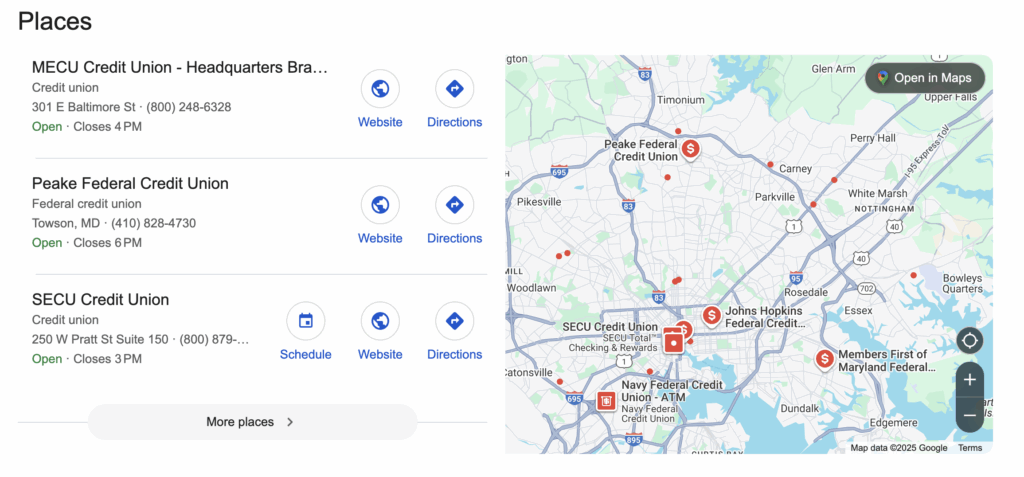
Show up locally
Optimize Google Business Profiles, branch pages, and map listings so members can easily find your nearest location.
Rank for intent-driven keywords
Terms like credit union auto loans, credit union SEO, or best local mortgage rates connect directly to member needs.
Build authority through education
Create helpful blog content that answers real questions: “How do credit union mortgage rates compare?” or “What are the benefits of a credit union credit card for students?”
Every search result, blog post, and local listing (a great local SEO tool for credit unions!) is a chance to build credibility before a member even clicks on your site.
“Given our credit union membership requirements, broad campaigns don’t work. We have to be very targeted in who we reach by geography and affiliation. A community-based approach to digital marketing campaigns demonstrates to prospective members our commitment to the communities we serve and to our members’ financial well-being.”
– Adam Curtis, Digital Content Manager, SECU Maryland
Step 2: Create Seamless, Member-Centered Experiences
Once members find you, the next question is, “Can I trust you to make this easy?”
The McKinsey research found that many credit unions lag behind competitor banks in both website usability and mobile experience. Fixing that doesn’t always mean a total redesign, but it does mean thinking like your members.
Ask:
- Can they find what they need within two clicks?
- Are your calls-to-action and buttons clear and consistent?
- Does your site look and perform just as well on mobile as on desktop?
Simple navigation, fast load times, and clear paths to apply or contact your team build confidence, and so does consistency. Your digital experience should feel consistent across your website, local listings, and social channels.
Step 3: Focus on Personalization and Lifetime Value
The best marketing for credit unions has always been relational. The challenge now is translating that connection online in a personal and meaningful way.
Consider focusing on lifetime value by building deeper, data-driven relationships rather than just chasing new accounts. That starts with personalized content and campaigns such as:
- Onboarding emails that help new members get started with your digital tools.
- Segmented marketing that tailors product recommendations to individual goals.
- Retention campaigns that re-engage inactive members with personalized offers.
When your outreach feels relevant and human, it reinforces what credit unions already do best: caring for members as people, not just numbers.
Dive deeper: How Our Local SEO Strategy Drives National Brand Authority for SECU
Step 4: Engage with Younger Generations
Younger consumers are shaping the future of banking, yet they’re the least likely to choose credit unions. Why? Because they don’t see them.
To attract younger audiences, credit unions need to meet them where they are and speak their language:
- Use short-form video and social storytelling to share your mission and community impact.
- Encourage members to leave Google reviews that reflect your authentic service.
- Highlight the people behind your organization, like staff, members, and volunteers, across your marketing.
See how this strategy worked for one of our Maryland credit union clients. When your digital presence mirrors the warmth and trust that members feel in person, you close the gap.
Gain Your Competitive Edge with Credit Union Marketing in 2026
Building digital trust is all about showing up clearly, consistently, and confidently in the places your members already are. Your SEO, content, and digital experience should work together to reflect who you are: a trusted, local partner that helps people thrive financially.
If your credit union is ready to modernize how you connect with members, Agency 102 would love to help. We partner with financial institutions to strengthen their online visibility, elevate their content, and create digital experiences that turn trust into growth.
Your members are searching. Let’s make sure they find you first.